
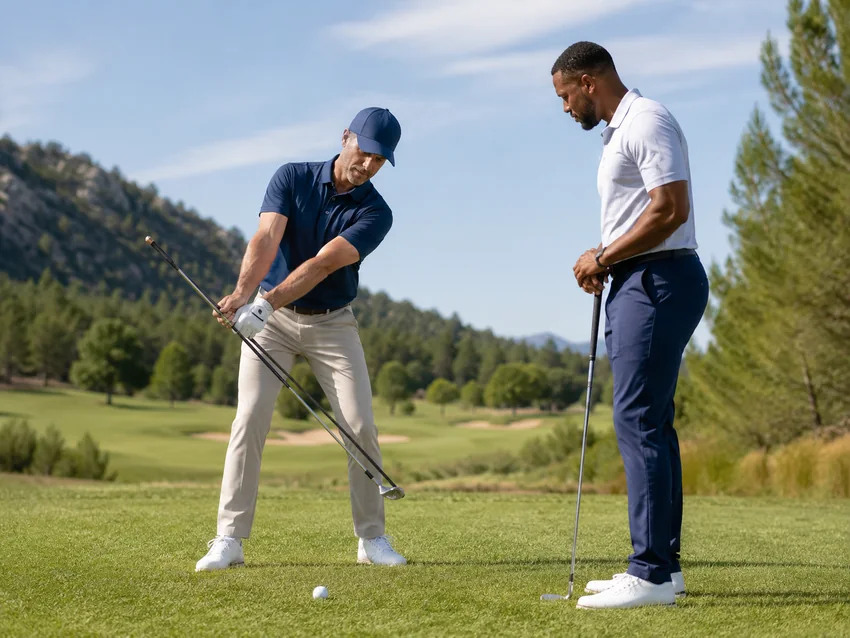
Choosing the right golf club length is about more than simply matching your clubs to your height.
Your height, wrist-to-floor measurement, arm length, posture, club type, and swing characteristics can all affect the length that works best for you. Two golfers who are the same height can need different club specifications because their proportions and swings are different.
So, what length golf clubs do you need?
As a starting point, use your height and wrist-to-floor measurement to estimate the appropriate length. Then consider your setup, ball striking, posture, and swing during a professional golf club fitting.
In this guide, you’ll learn how to:
- Determine the right golf club length for your height
- Measure your wrist-to-floor distance correctly
- Use a golf club length chart
- Understand standard golf club lengths
- Choose the right length for drivers, woods, hybrids, irons, wedges and putters
- Recognize signs that your clubs may be too long or too short
- Understand how club length affects distance, accuracy and consistency
- Know when professional club fitting is worthwhile
Quick Answer: What Length Golf Clubs Do I Need?
The right golf club length depends on more than your height.
For a useful starting point, measure:
- Your height
- Your wrist-to-floor distance
Then consider the club type, your posture, arm length, and swing characteristics.
Height can help determine whether you may need shorter, standard, or longer clubs, but it should not be used by itself to choose your exact specifications.
A golf club length chart can give you a starting recommendation, but a professional fitting is more accurate because it evaluates how you actually interact with the club.
Why Does Golf Club Length Matter?
Golf club length affects how you stand over the ball, where your hands sit at address, the club’s swing geometry, and how consistently you can strike the ball.
If a club is too long, you may have difficulty controlling it or maintaining your normal setup. If it is too short, you may compensate by bending excessively or changing your posture.
The right length can help you maintain:
- A comfortable address position
- Consistent posture
- Appropriate hand position
- Better control
- More consistent strike location
- Consistent swing mechanics
- More predictable ball flight
However, longer does not automatically mean better.
A longer club can potentially increase clubhead speed, but if you struggle to control it or consistently find the center of the face, the potential distance benefit may disappear.
For most golfers, the goal is to find the length that provides the best combination of speed, control, and consistent contact.
Does Height Determine Golf Club Length?
Height is an important starting point, but it does not determine your exact golf club length.
Two golfers can both be 6 feet tall but have different arm lengths and wrist-to-floor measurements. Their ideal club specifications may therefore be different.
This is why club fitting generally considers both height and wrist-to-floor measurement rather than relying on height alone.
Your posture and swing can also influence the final recommendation.
For example, a golfer who naturally sets up more upright may need a different specification from another golfer of the same height who sets up differently.
What Is Wrist-to-Floor Measurement?
Your wrist-to-floor measurement is the distance from the crease of your wrist to the floor when you are standing naturally.
It helps account for differences in arm length between golfers who may otherwise appear similar based on height alone.
This makes wrist-to-floor measurement useful when estimating whether you should consider standard, shorter, or longer club specifications.
How to Measure Wrist-to-Floor
For a useful measurement:
- Stand naturally on a hard, level surface.
- Wear the shoes you normally use for golf.
- Keep your arms relaxed at your sides.
- Do not reach toward the floor or change your posture.
- Measure from the crease of your wrist straight down to the floor.
- Record the measurement in inches.
Ideally, have another person measure so you can maintain a natural standing position.
Your wrist-to-floor measurement should be used together with your height, not as a standalone measurement.
Golf Club Length Chart: How Should You Use One?
A golf club length chart can help you estimate whether you should start with standard, shorter, or longer club specifications.
However, a chart is a starting point rather than a final fitting prescription.
A typical fitting process considers:
- Height
- Wrist-to-floor measurement
- Arm length
- Posture
- Club type
- Lie angle
- Swing characteristics
- Strike location
- Ball flight
- Clubhead speed
- Player preferences
Because manufacturers can use different specifications for their clubs, there is also no single universal “standard length” that applies to every brand or model.
Use a chart to narrow down your options, then test the specification whenever possible.
What Is the Standard Length of a Golf Club?
There is no single standard length for every golf club.
Drivers, fairway woods, hybrids, irons, wedges, and putters are all built to different lengths because each club has a different purpose.
Even within the same club category, manufacturers and models can have different specifications.
For example:
- Drivers are generally the longest clubs in the bag.
- Fairway woods are shorter than drivers.
- Hybrids are generally shorter than fairway woods.
- Irons become progressively shorter as loft increases.
- Wedges are shorter than most irons.
- Putter length depends heavily on your putting setup and stroke.
This is why asking for the “standard golf club length” without specifying the club can be misleading.
What Length Golf Clubs Do I Need by Club Type?
The correct length can vary depending on which club you are fitting.
Driver Length
Drivers are generally the longest clubs in the golf bag and are designed to maximize distance from the tee.
A longer driver can potentially increase clubhead speed, but it can also make the club harder to control.
If a golfer cannot consistently strike the center of the clubface, a slightly shorter driver may produce better overall results even if the theoretical swing speed is lower.
The best driver length is therefore a balance between speed, centered contact, and control.
Fairway Wood Length
Fairway woods are shorter than drivers and are designed for long shots from the fairway, rough, or tee.
The appropriate length depends on the specific wood, the golfer’s measurements, and how comfortably they can control the club.
Hybrid Length
Hybrids generally fall between woods and irons in both design and length.
They can provide an alternative to longer irons for golfers who want easier launch, additional forgiveness, or a different trajectory.
Iron Length
Iron lengths progressively change throughout the set.
Longer irons are built longer than shorter irons, helping create differences in launch, speed, and distance between clubs.
The right iron length should allow you to establish a consistent setup while maintaining control and centered contact.
Wedge Length
Wedges are generally shorter than irons and are designed for control, approach shots, and short-game situations.
Because wedges are used for precision, control and consistent contact are particularly important when determining their specifications.
Putter Length
Putter length is different from many other clubs because it is strongly influenced by your putting setup.
Your:
- Posture
- Arm position
- Hand position
- Eye position
- Stroke
- Address position
can all influence which putter length works best.
Height alone should not be used to choose your putter length.
Does Shaft Length Affect Distance?
It can, but more length does not automatically produce more distance.
A longer shaft can potentially increase clubhead speed because the club travels through a larger arc.
However, additional length can also make a club more difficult to control. If it causes inconsistent contact, the golfer may lose ball speed despite having the potential for greater clubhead speed.
For many golfers, center-face contact is more important than simply increasing shaft length.
The best club length allows you to create speed while maintaining control and a consistent strike.
What Happens If Golf Clubs Are Too Long?
Golf clubs that are too long can affect your setup, swing, and ability to control the club.
Potential signs include:
- Standing too far from the ball
- An altered posture
- Inconsistent contact
- Difficulty controlling the clubface
- Changes in swing path
- Inconsistent ball flight
- Toe strikes or other inconsistent strike patterns
These symptoms do not automatically mean that your clubs are too long. Swing technique, lie angle, and other equipment factors can produce similar results.
A professional fitting can help identify the actual cause.
What Happens If Golf Clubs Are Too Short?
Clubs that are too short can also cause setup and swing compensations.
Potential signs include:
- Excessive bending at address
- Standing too close to the ball
- Changes in posture
- Inconsistent strike location
- Changes to your swing mechanics
- Difficulty maintaining a comfortable setup
Again, these signs can have multiple causes, so club length should be assessed alongside the rest of your equipment and swing.
How Does Club Length Affect Lie Angle?
Club length and lie angle are closely connected during a golf club fitting.
Lie angle describes the angle between the shaft and the sole of the club.
Changing the length of a club can affect how the club sits relative to the ground. If the length or lie angle is not appropriate for the golfer, it can influence strike and directional performance.
This is one reason why simply adding or removing length from a golf club is not always the complete solution.
A fitter should evaluate the club as a complete system.
How Do I Measure Golf Club Length?
Golf club length should be measured using the appropriate method for the club and its playing position.
For many clubs, the measurement is taken with the club positioned correctly and the sole placed in its intended playing position.
The exact measurement method can vary depending on the club design and manufacturer, so measurements should be compared carefully with the manufacturer’s published specifications.
If you are checking your existing clubs, first identify the manufacturer’s stated length for that specific model.
Can I Choose Golf Club Length Based on Height?
Yes, but only as a starting point.
Height is useful for estimating club length, but it does not account for your arm length, wrist-to-floor measurement, posture, or swing.
A better process is:
Height → Wrist-to-floor measurement → Club type → Setup → Swing → Testing → Final specification
This approach gives you a much better starting point than choosing clubs based on height alone.
What Length Golf Clubs Should Beginners Use?
Beginners do not automatically need a particular club length simply because they are new to golf.
The same basic fitting principles apply:
Height + wrist-to-floor measurement + posture + club type + swing characteristics
For beginners, control and consistent contact can be especially important.
Choosing the longest possible club is not necessarily the best way to gain distance. A club that allows a new golfer to establish a comfortable setup and make consistent contact can be more useful for developing their swing.
What Length Golf Clubs Do Women Need?
There is no single club length that is correct for every woman.
Women’s golf clubs are often manufactured with different standard specifications, but individual fitting factors still matter.
Height, wrist-to-floor measurement, arm length, posture, and swing characteristics should all be considered.
A shorter woman and a taller woman may require different specifications, just as two men of the same height may require different specifications.
The best approach is to fit the golfer rather than relying solely on gender-based standards.
What Length Golf Clubs Do Tall Golfers Need?
Tall golfers may need longer-than-standard clubs, but height alone does not guarantee that they will.
Arm length and wrist-to-floor measurement are important because two tall golfers can have different body proportions.
A professional fitting can determine whether additional length is actually beneficial and whether other specifications, such as lie angle, also need to change.
What Length Golf Clubs Do Short Golfers Need?
Shorter golfers may benefit from shorter-than-standard clubs, but the final recommendation should not be based on height alone.
Wrist-to-floor measurement, posture, arm length, and lie angle can all affect the appropriate specification.
The objective is to find a club length that allows you to establish a comfortable setup and make consistent contact.
Can I Change the Length of My Existing Golf Clubs?
In some cases, golf clubs can be lengthened or shortened.
However, changing club length can affect other specifications, including swing weight and potentially lie angle.
That means you should not automatically modify your clubs based on a height chart alone.
If you already like your current clubs, have them evaluated by a professional fitter before deciding whether to modify or replace them.
Should I Get Professionally Fitted for Golf Club Length?
If you want the most reliable answer, professional fitting is the best option.
A height and wrist-to-floor measurement can provide a useful starting point, but a professional fitter can evaluate what happens when you actually swing the club.
A fitting can consider:
- Height
- Wrist-to-floor measurement
- Posture
- Hand position
- Club length
- Lie angle
- Shaft weight
- Shaft flex
- Clubhead characteristics
- Swing speed
- Strike location
- Ball flight
- Consistency
This is particularly useful if you are:
- Buying a new set of clubs
- Struggling with inconsistent contact
- Unsure whether your clubs are too long or too short
- Changing your swing
- Experiencing inconsistent ball flight
- Looking to improve your equipment setup
Get Your Golf Clubs Fitted to You
Don’t guess your club length based on height alone.
At SwingFit, a professional club fitting can help determine the specifications that best match your measurements, swing, and goals.
Book a custom golf club fitting with SwingFit and find out whether your current club length is helping or holding back your game.
[Book Your Golf Club Fitting]
Frequently Asked Questions
What length golf clubs do I need?
The right length depends on your height, wrist-to-floor measurement, arm length, posture, club type, and swing characteristics. Use height and wrist-to-floor measurement as a starting point, then test the specification or get professionally fitted.
Does my height determine what length golf clubs I need?
No. Height is useful for estimating club length, but it does not determine the exact specification. Wrist-to-floor measurement, posture, arm length, and swing characteristics can change the recommendation.
How do I measure myself for golf clubs?
Measure your height and wrist-to-floor distance while standing naturally. These measurements can then be compared with a golf club length chart or assessed by a professional club fitter.
Is wrist-to-floor measurement important for golf club length?
Yes. It helps account for differences in arm length between golfers of the same height and provides a more useful starting point than height alone.
Are longer golf clubs better?
Not necessarily. Longer clubs can potentially increase clubhead speed, but they can also be more difficult to control. The best length provides an appropriate balance of speed, control, and consistent contact.
What happens if my golf clubs are too long?
Clubs that are too long can affect your posture, distance from the ball, strike location, and control. However, similar symptoms can be caused by lie angle or swing mechanics, so professional evaluation is useful.
What happens if my golf clubs are too short?
Clubs that are too short can cause changes in posture and setup and may contribute to inconsistent contact. Other fitting factors should also be considered before changing club length.
Should I use a golf club length chart?
Yes. A chart is a useful starting point for estimating club length from your measurements, but it cannot account for every part of your setup and swing.
Can I get my existing golf clubs lengthened or shortened?
Sometimes. However, changing club length can affect swing weight and other specifications, so your clubs should be assessed before modification.
Should I get fitted for golf club length?
A professional fitting is recommended if you are buying new clubs, struggling with consistency, changing your swing, or unsure whether your current clubs are the correct length.
Final Thoughts
The answer to “What length golf clubs do I need?” is not determined by height alone.
Your height and wrist-to-floor measurement provide a useful starting point, but the right club length also depends on your posture, arm length, club type, swing, and how consistently you can control and strike the club.
A golf club length chart can help narrow down your options, but testing different specifications or working with a professional fitter can give you a much more reliable answer.
The goal is not to find the longest or shortest club possible.
The goal is to find a club length that helps you set up comfortably, strike the ball consistently, and control your shots.
If you’re unsure whether your current clubs are the right length, a professional SwingFit fitting can help you find the specification that matches your body and your swing.